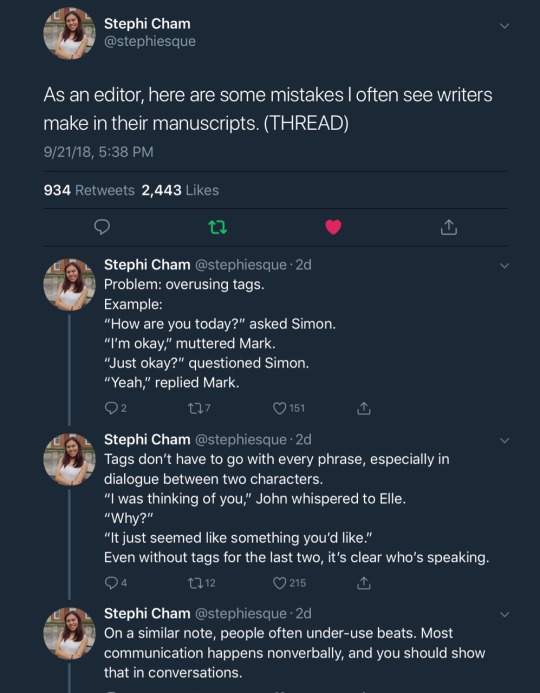
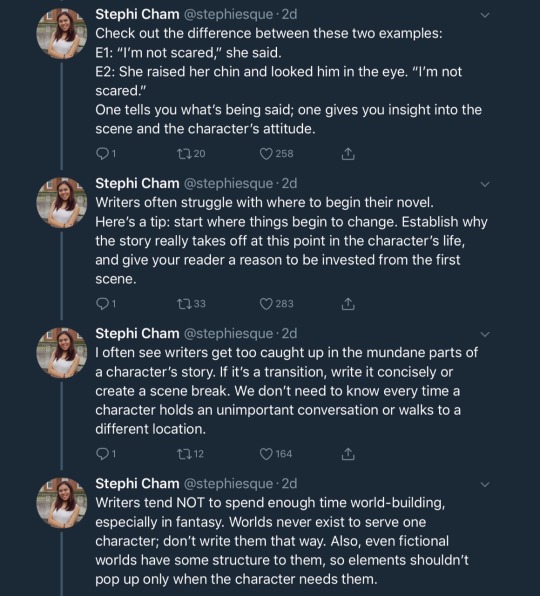
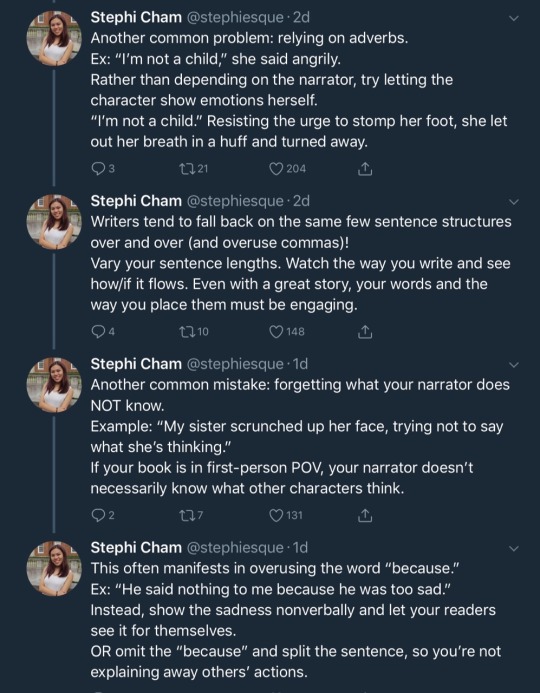
This. This is good fiction writing advice. I really appreciate how it was formatted as “this is a common problem, here is a solution to try in your own work” and not “oh god, don’t do that!” without any extra help. And I extra appreciated the “don’t rely on adverbs” bit, because they do have their place but they aren’t the only way actions can be emphasized.
PLEASE REBLOG AND ADD ANY OTHERS YOU MIGHT KNOW OF ❤ ❤
WOOKIEEPEDIA. The source of anything and everything you want to know related to Star Wars. Good for fact-checking, character history, or simply killing time. There is also, of course, the official Star Wars Databank!
TIMELINE. While hosted on Wookieepedia, this is nevertheless deserving of its own bullet point. This page provides an approximate timeline with dates of all canon material. You can also filter items, so that it displays only TV episodes, for example, or only books, or only movies! Find the Legends timeline here.
STAR WARS SLANG AND PHRASES. A collection I’ve been keeping of phases, slang, idioms, insults, and more from the Star Wars universe. This also contains a glossary of frequently used terms, such as “refresher” in place of “restroom”. Please feel free to use/share!
STAR WARS NAME GENERATOR. This is a fun one AND a life saver. You can generate up to 100 Star Wars-sounding names ( first and last! ) with a click.
So, let me guess— you just started a new book, right? And you’re stumped. You have no idea how much an AK47 goes for nowadays. I get ya, cousin. Tough world we live in. A writer’s gotta know, but them NSA hounds are after ya 24/7. I know, cousin, I know. If there was only a way to find out all of this rather edgy information without getting yourself in trouble…
You’re in luck, cousin. I have just the thing for ya.
I got your back, cousin. Just head over to Havocscope.
((PS: In case you’re wondering, Havocscope is a database full of information regarding the criminal underworld. The information you will find there has been taken from newspapers and police reports. It’s perfectly legal, no need to worry about the NSA hounds, cousin ;p))
No. The
Force has no conscience, it just is. It’s part of nature, not some omnipotent and
omniscient entity. The “will of the Force” is something the Jedi (and most
force-sensitives groups) came up to explain their relationship with the Force.
If something happened that had no logical explanation they knew of, it was the
will of the Force, if they needed justify their actions it was the will of the
force, etc.
Experimenting
with the Force, in most cases, is considered wrong because the Jedi said so. Many groups deal
with the Force their own way, the ones the Jedi Order deems tolerable are allow
to keep existing. The ones they consider wrong are destroyed (the Sith). But,
to be fair, the Sith used the Force for some pretty nasty things and the Force,
being part of nature of the galaxy, was more than just something to
experimented on indiscriminately. Too much meddling could lead to the entire
galaxy to dangerous places.
And then
the Jedi declared that to be born with Force powers was not a gift or a curse.
They insisted it was a calling. They
proclaimed the Force should never be used for selfish purposes, that all
Force-sensitive beings were obligated to use their powers for the benefit of
others. Many Force users joined the Jedi Order, but the Jedi were not
satisfied with their numbers. They
sought out the so-called wizards and demons, and gave them three options. Join
the Jedi, cease using Force powers, or die. [Darh Maul in Ryder Windham’s
The wrath of Darth Maul]
The Jedi
Order politicized the Force to keep their control over the galaxy. They had a
Force monopoly going on. They mixed politics with religion and things slowly
got mixed up. it got to a point they no longer could separate their political
goals from their religious ones. The will of the Senate/Council became the will
of the Force. Something that
was used to explain coincidences became a justification of the Council’s
decisions.
There isn’t
much scientific experimentation with the Force within the Jedi Order because they
prohibited, because it serves their political goals better.
“As Jedi learn more about the Force, it is
not unusual for them to form their own theories about how and why it works. They
question how, if the Force creates and sustains life, it can have a dark side.
Some arrive at the conclusion that the Force is not divided into dark and
light, that its energy is inherently positive, and that there is no “dark side”
waiting to corrupt them. Time and again, this conclusion has been proved
erroneous, and the Jedi who felt
compelled to test the limits of the Force rarely perceived the dangers of their
explorations. As they approached the brink of the dark side, some were
rescued by other Jedi or came back willingly when they saw the error of their
ways. Those who refused to renounce
their mistaken the beliefs were either exiled to the farthest reaches of the
galaxy, or destroyed.[Ryder’s Windham’s Jedi vs. Sith: The
Essential Guide to the Force]
The “balance” was another example of force-sensitives politicizing the
Force. The Sith wanted a chosen one to kill all the Jedi and the Jedi wanted a
chosen one to kill all the sith. But, truth is, the Force did balance itself
out when it created Anakin. the Sith vs Jedi conflict was political. Anakin
existence was enough, he didn’t HAVE to become a sith or a Jedi. all they had
to do was let nature take its course, you know, follow the “will of the Force”.
[Plagueis] had to see this Anakin Skywalker
for himself; had to sense him for himself. He had to know if the Force had
struck back again, nine years earlier, by
conceiving a human being to restore balance to the galaxy. […] There was
still a chance that the Council would decide that Anakin was too old to be
trained as a Jedi. That way, assuming he was returned to Tatooine … But if
not … If Qui-Gon managed to sway the Council Masters, and they
reneged on their own dictates …
Plagueis ran a hand over his forehead. Are we undone? he thought. Have you
undone us? [James Luceno. Darth Plagueis]
Plagueis knew enough to understand Anakin didn’t have to become a sith
or a Jedi to be a threat and do his job, something the Jedi never figured out
because they were too busy forcing Anakin to be exactly like them.
Wow, that is a tough question. I haven’t read any of the old Legends stuff about growing up Jedi, so I’m just going to comment on what we see in the films and Clone Wars cartoon.
It’s important to note that no one, with the possible exception of Anakin, actually consented to join the Jedi. They were all drafted as infants or toddlers. From a very young age they are groomed for combat. @howtofightwrite has some excellent posts about children raised for combat. The goal of the Jedi Order’s childrearing and training practices is to create effective fighters with an intense loyalty to the Order and the cause they serve. They accomplish this through isolation, indoctrination, and the rigorous suppression of dissent. Children are pushed to do and be their best, but I seriously doubt that the Order is going to do anything which endangers their health before the age of ten or so. They aren’t going to beat them. They aren’t going to train them to the point of injury. Force-sensitive kids are a rare and precious commodity and the Order isn’t going to risk losing them to injury or the Darth Side.
By the time the kids are ten or so, then they’re willing to endanger them. We see this during the Gathering arc. The kids are sent into a cave where they undergo a test of character involving hallucinations, extreme temperatures, and potentially life-threatening situations. Ezra and Luke undergo something similar during the course of their training. Everyone consents to participating, but none of the people involve fully understand what they’re about to endure. In the case of Ezra, we see real proof that people have died during the test. We don’t know if anyone has died during the Gathering, but it is presented to the children as a real possibility at the outset. Tests for children that conceivably involve dying if you fail is pretty fucked up.
Tests and object lessons remain a pretty consistent thing with the Jedi from this point on. Initiates have to pass the Padawan Trials. Padawans have to pass the Knight Trials. Knights are assigned padawans to test their ability to handle losing said padawan. Teenagers are repeatedly placed in deadly situations with minimal support to see if they survive. A group of children are kidnapped and left to fend for themselves as Council members declare they’ll be fine and find their own way back if they’re worthy students.
This is all deeply fucked up and symptomatic of the way the Order views it’s members. Jedi, regardless of age, are disposable resources meant to serve a greater purpose. This is fundamentally dehumanizing and results in the various emotionally stunted messes we see on screen.
@howtofightwrite writes in another post about abusive trainers that the key to understanding abusive training scenarios is all about control. Abusive trainers want their trainees to serve them, their needs, and their interests, regardless of what is good for the trainee. I’m just going to quote a few paragraphs from the original post rather than rephrase because it’s just too perfect:
A character with an abusive instructor may become a great fighter, but they will also be emotionally crippled. Like a bully, they will feel the need to exert control over their environment, create their own little kingdoms, and lash out at those who threaten their authority.
A character who cannot embrace their teacher’s outlook will be shattered, chased by self-doubt, and end up too mentally insecure to succeed at warfare. Their confidence is crushed, and whatever they learn from their teacher they don’t have the fortitude to use.
That’s the consequence of an abusive instructor.
You embrace them and become like them.
Or…
You reject them, and they break you.
This is not physical, they break their student emotionally through neglect, through failure, by critically hampering their ability to succeed, by undercutting them, or changing the goalposts on them.
This is literally what happens to Anakin. We see this happen to him over the course of the Clone Wars series and films. We also see them do this to Ahsoka, especially during her trials. We also see a bit of this with Caleb in the Kanan comics when he gets yelled at for asking questions.
And so, to sum up, yes, the Jedi Order was an abusive training environment. They didn’t beat the initiates, but they did recklessly endanger their lives and emotional wellbeing as part of various tests. Their end goal was not to create functional, successful adults, but rather soldiers blindly fighting for their cause and they psychologically broke anyone who didn’t immediately fall in line.
Sticking a landing will royally fuck up your joints and possibly shatter your ankles, depending on how high you’re jumping/falling from. There’s a very good reason free-runners dive and roll.
Hand-to-hand fights usually only last a matter of seconds, sometimes a few minutes. It’s exhausting work and unless you have a lot of training and history with hand-to-hand combat, you’re going to tire out really fast.
Arrows are very effective and you can’t just yank them out without doing a lot of damage. Most of the time the head of the arrow will break off inside the body if you try pulling it out, and arrows are built to pierce deep. An arrow wound demands medical attention.
Throwing your opponent across the room is really not all that smart. You’re giving them the chance to get up and run away. Unless you’re trying to put distance between you so you can shoot them or something, don’t throw them.
Everyone has something called a “flinch response” when they fight. This is pretty much the brain’s way of telling you “get the fuck out of here or we’re gonna die.” Experienced fighters have trained to suppress this. Think about how long your character has been fighting. A character in a fist fight for the first time is going to take a few hits before their survival instinct kicks in and they start hitting back. A character in a fist fight for the eighth time that week is going to respond a little differently.
ADRENALINE WORKS AGAINST YOU WHEN YOU FIGHT. THIS IS IMPORTANT. A lot of times people think that adrenaline will kick in and give you some badass fighting skills, but it’s actually the opposite. Adrenaline is what tires you out in a battle and it also affects the fighter’s efficacy – meaning it makes them shaky and inaccurate, and overall they lose about 60% of their fighting skill because their brain is focusing on not dying. Adrenaline keeps you alive, it doesn’t give you the skill to pull off a perfect roundhouse kick to the opponent’s face.
Swords WILL bend or break if you hit something hard enough. They also dull easily and take a lot of maintenance. In reality, someone who fights with a sword would have to have to repair or replace it constantly.
Fights get messy. There’s blood and sweat everywhere, and that will make it hard to hold your weapon or get a good grip on someone.
A serious battle also smells horrible. There’s lots of sweat, but also the smell of urine and feces. After someone dies, their bowels and bladder empty. There might also be some questionable things on the ground which can be very psychologically traumatizing. Remember to think about all of the character’s senses when they’re in a fight. Everything WILL affect them in some way.
If your sword is sharpened down to a fine edge, the rest of the blade can’t go through the cut you make. You’ll just end up putting a tiny, shallow scratch in the surface of whatever you strike, and you could probably break your sword.
ARCHERS ARE STRONG TOO. Have you ever drawn a bow? It takes a lot of strength, especially when you’re shooting a bow with a higher draw weight. Draw weight basically means “the amount of force you have to use to pull this sucker back enough to fire it.” To give you an idea of how that works, here’s a helpful link to tell you about finding bow sizes and draw weights for your characters. (CLICK ME)
If an archer has to use a bow they’re not used to, it will probably throw them off a little until they’ve done a few practice shots with it and figured out its draw weight and stability.
People bleed. If they get punched in the face, they’ll probably get a bloody nose. If they get stabbed or cut somehow, they’ll bleed accordingly. And if they’ve been fighting for a while, they’ve got a LOT of blood rushing around to provide them with oxygen. They’re going to bleed a lot.
Here’s a link to a chart to show you how much blood a person can lose without dying. (CLICK ME)
If you want a more in-depth medical chart, try this one. (CLICK ME)
Hopefully this helps someone out there. If you reblog, feel free to add more tips for writers or correct anything I’ve gotten wrong here.
How to apply Writing techniques for action scenes:
– Short sentences. Choppy. One action, then another. When there’s a lull in the fight, take a moment, using longer phrases to analyze the situation–then dive back in. Snap, snap, snap. – Same thing with words – short, simple, and strong in the thick of battle. Save the longer syllables for elsewhere. – Characters do not dwell on things when they are in the heat of the moment. They will get punched in the face. Focus on actions, not thoughts. – Go back and cut out as many adverbs as possible. – No seriously, if there’s ever a time to use the strongest verbs in your vocabulary – Bellow, thrash, heave, shriek, snarl, splinter, bolt, hurtle, crumble, shatter, charge, raze – it’s now. – Don’t forget your other senses. People might not even be sure what they saw during a fight, but they always know how they felt. – Taste: Dry mouth, salt from sweat, copper tang from blood, etc – Smell: OP nailed it – Touch: Headache, sore muscles, tense muscles, exhaustion, blood pounding. Bruised knuckles/bowstring fingers. Injuries that ache and pulse, sting and flare white hot with pain. – Pain will stay with a character. Even if it’s minor. – Sound and sight might blur or sharpen depending on the character and their experience/exhaustion. Colors and quick movements will catch the eye. Loud sounds or noises from behind may serve as a fighter’s only alert before an attack. – If something unexpected happens, shifting the character’s whole attention to that thing will shift the Audience’s attention, too. – Aftermath. This is where the details resurface, the characters pick up things they cast aside during the fight, both literally and metaphorically. Fights are chaotic, fast paced, and self-centered. Characters know only their self, their goals, what’s in their way, and the quickest way around those threats. The aftermath is when people can regain their emotions, their relationships, their rationality/introspection, and anything else they couldn’t afford to think or feel while their lives were on the line.
Do everything you can to keep the fight here and now. Maximize the physical, minimize the theoretical. Keep things immediate – no theories or what ifs.
If writing a strategist, who needs to think ahead, try this: keep strategy to before-and-after fights. Lay out plans in calm periods, try to guess what enemies are thinking or what they will do. During combat, however, the character should think about his options, enemies, and terrain in immediate terms; that is, in shapes and direction. (Large enemy rushing me; dive left, circle around / Scaffolding on fire, pool below me / two foes helping each other, separate them.)
Lastly, after writing, read it aloud. Anyplace your tongue catches up on a fast moving scene, edit. Smooth action scenes rarely come on the first try.
More for martial arts or hand-to-hand in general
What a character’s wearing will affect how they fight. The more restricting the clothes, the harder it will be. If they’re wearing a skirt that is loose enough to fight in, modesty will be lost in a life or death situation.
Jewelry can also be very bad. Necklaces can be grabbed onto. Bracelets also can be grabbed onto or inhibit movement. Rings it can depend on the person.
Shoes also matter. Tennis shoes are good and solid, but if you’re unused to them there’s a chance of accidentally hurting your ankle. High heels can definitely be a problem. However, they can also make very good weapons, especially for someone used to balancing on the balls of their feet. Side kicks and thrusting kicks in soft areas (like the solar plexus) or the feet are good ideas. They can also (hopefully) be taken off quickly and used as a hand weapon. Combat boots are great but if someone relies more on speed or aren’t used to them, they can weigh a person down. Cowboy boots can be surprisingly good. Spin kicks (if a character is quick enough to use them) are especially nasty in these shoes.
If a character is going to fight barefoot, please keep location in mind. Concrete can mess up your feet quick. Lawns, yards, etc often have hidden holes and other obstacles that can mess up a fighter. Tile floors or waxed wood can be very slippery if you’re not careful or used to them.
Likewise, if it’s outside be aware of how weather will affect the fight. The sun’s glare can really impede a fighter’s sight. A wet location, inside or outside, can cause a fighter to slip and fall. Sweat on the body can cause a fighter to lose a grip on an opponent too.
Pressure points for a trained fighter are great places to aim for in a fight. The solar plexus is another great place to aim for. It will knock the wind out of anyone and immediately weaken your opponent.
It your character is hit in the solar plexus and isn’t trained, they’re going down. The first time you get hit there you are out of breath and most people double over in confusion and pain. If a fighter is more used to it, they will stand tall and expand themselves in order to get some breath. They will likely keep fighting, but until their breath returns to normal, they will be considerably weaker.
Do not be afraid to have your character use obstacles in their environment. Pillars, boxes, bookshelves, doors, etc. They put distance between you and an opponent which can allow you to catch your breath.
Do not be afraid to have your character use objects in their environment. Someone’s coming at you with a spear, trident, etc, then pick up a chair and get it caught in the legs or use it as a shield. Bedsheets can make a good distraction and tangle someone up. Someone’s invading your home and you need to defend yourself? Throw a lamp. Anything can be turned into a weapon.
Guns often miss their targets at longer distances, even by those who have trained heavily with them. They can also be easier to disarm as they only shoot in one direction. However, depending on the type, grabbing onto the top is a very very bad idea. There is a good likelihood you WILL get hurt.
Knives are nasty weapons by someone who knows what they’re doing. Good fighters never hold a knife the way you would when cutting food. It is best used when held against the forearm. In defense, this makes a block more effective and in offense, slashing movement from any direction are going to be bad. If a character is in a fight with a knife or trying to disarm one, they will get hurt.
Soft areas hit with hard body parts. Hard areas hit with soft body parts. The neck, stomach, and other soft areas are best hit with punches, side kicks, elbows, and other hard body parts. Head and other hard parts are best hit using a knife hand, palm strike, etc. Spin kicks will be nasty regardless of what you’re aiming for it they land.
Common misconception with round house kicks is that you’re hitting with the top of the foot. You’re hitting with the ball. You’re likely to break your foot when hitting with the top.
When punching, the thumb is outside of the fist. You’ll break something if you’re hitting with the thumb inside, which a lot of inexperienced fighters do.
Also, punching the face or jaw can hurt.
It can be hard to grab a punch if you’re not experienced with it despite how easy movies make it seem. It’s best to dodge or redirect it.
Hitting to the head is not always the best idea. It can take a bit of training to be able to reach for the head with a kick because of the height. Flexibility is very much needed. If there are problems with their hips or they just aren’t very flexible, kicks to the head aren’t happening.
Jump kicks are a good way to hit the head, but an opponent will see it coming if it’s too slow or they are fast/experienced.
A good kick can throw an opponent back or knock them to the ground. If the person you’ve hit has experience though, they’ll immediately be getting up again.
Even if they’ve trained for years in a martial art, if they haven’t actually hit anything before or gotten hit, it will be slightly stunning for the person. It does not feel the way you expect it too.
Those yells in martial arts are not just for show. If done right, they tighten your core making it easier to take a hit in that area. Also, they can be used to intimidate an opponent. Yelling or screaming right by their ear can startle someone. (Generally, KHR fans look at Squalo for yelling)
Biting can also be used if someone’s grabbing you. Spitting in someone’s eyes can’t hurt. Also, in a chokehold or if someone is trying to grab your neck in general, PUT YOU CHIN DOWN. This cuts off access and if they’re grabbing in the front can dig into their hand and hurt.
Wrist grabs and other grabs can be good. Especially if it’s the first move an opponent makes and the character is trained, there are simple ways to counter that will have a person on their knees in seconds..
Use what your character has to their advantage. If they’re smaller or have less mass, then they’ll be relying on speed, intelligence, evasion, and other similar tactics. Larger opponents will be able to take hits better, they’re hits may be slower depending on who it is but will hurt like hell if they land, and size can be intimidating. Taller people with longer legs will want to rely on kicking and keeping their distance since they have the advantage there. Shorter people will want to keep the distance closer where it’s easier for them but harder for a taller opponent. Punching is a good idea.
Using a person’s momentum against them is great. There’s martial arts that revolve around this whole concept. They throw a punch? Grab it and pull them forward and around. Their momentum will keep them going and knock them off balance.
Leverage can used in the same way. If used right, you can flip a person, dislocate a shoulder, throw out a knee, etc.
One note on adrenaline: All that was said above is true about it. But, in a fight, it can also make you more aware of what’s going on. A fight that lasts twenty seconds can feel like a minute because time seems to almost slow down while moving extremely rapidly. You only have so much time to think about what you’re doing. You’re taking in information constantly and trying to adjust. Even in the slow down adrenaline gives you, everything is moving very rapidly.
Feelings will be your downfall even more so than adrenaline. Adrenaline can make those feelings more intense, but a good fighter has learned not to listen to those feelings. A good fighter may feel anger at being knocked down or in some way humiliated – their pride taken down. Yet they will not act on the anger. Acting on it makes a fighter more instinctive and many will charge without thinking. Losing control of anything (adrenaline rush, emotions, technique, etc) can be a terrible thing in a fight.
Canon:
canon!Anakin is reserved and most people considered him mysterious/sad/burdened.
Only a few people in canon ever saw him smile or laugh. He is incredibly intelligent
and hardworking. Anakin is known to be awkward and not having the best social
skills. He often described as extremely generous, compassionate, patient,
gentle and forgiving. I think the best to way to understand a character is to
look at how they are perceived by other characters.
“I’m not
speaking of your power, Anakin, but of your heart. The greatness in you is a
greatness of spirit. Courage and
generosity, compassionand commitment.
These are your virtues,” Obi-Wan said gently. “You have done great things,
and I am very proud of you.” [Matthew Stover’s Revenge of the Sith]
“A man who
knew exactly what he wanted and was honest
enough to simply ask for it; a man strong
enough to unroll his deepest feelings before her without fear and without shame. A man who had loved her for a
decade, with faithful and patient heart,
while he waited for the act of destiny he was sure would someday open her own
heart to the fire in his. [Matthew Stover’s Revenge of the Sith]
“[Anakin]
is not a perfect man: he is prideful,
and moody, and quick to anger—but these faults only make her love him the more,
for his every flaw is more than balanced by the greatness within him, his capacity for joy and cleansing laughter,
his extraordinary generosity of spirit,
his passionate devotion not only to
her but also in the service of every living being.” [Matthew Stover’s Revenge
of the Sith]
“He thought
of how unflinchingly loyal Anakin was
to anyone he considered a friend.” [Matthew Stover’s Revenge of the Sith]
“Ferus did
not allow for the goodness of Anakin’s
heart. He did not see how hard
Anakin tried. He did not know that Anakin
questioned himself all the time.” [Jude Watson’s The Changing of the Guard]
It’s not
just Skywalker’s rank that makes us give him one hundred percent. It’s because he treats us with respect, and he
puts himself on the line with us.” [The Clone Wars by Karen Traviss]
“He feels too much, too keenly. Maybe
that’s what happens when you’ve got the highest midi-chlorian count in Jedi
history. Maybe that’s the trade-off. You
feel everything, so you’re brilliant. You feel everything, and it hurts. [Karen
Miller’s Clone Wars Gambit: Stealth]
“Sometimes [Ahsoka]
even deliberately flouted his wishes. Anything to break him free of sorrow or frustration or some bleak memory he refused
to share. Anything to let him know, Hey, what you did then? That was
stupid. But mostly she kept her fears for him to herself, because all his bright and burning passion for justice, his
reckless courage, his hunger for victory and his refusal to accept defeat—they
were what made him Anakin. He wouldn’t be Anakin without his feelings. [Karen Miller’s Clone Wars Gambit: Stealth]
Obi-Wan
stifled a sigh. Oh Anakin. This was about his childhood. Again. About the indelible fingerprints slavery had left on
his soul and his psyche. [Karen Miller’s Clone
Wars Gambit: Stealth]
The fear and dread in her face eased, just a little. “You’re a very sweet young man, Anakin
Skywalker.” [Karen Miller’s Clone Wars Gambit: Stealth]
[Anakin]
humbles me, sometimes. He makes me feel small. He can’t see a broken thing
without wanting to fix it. [Karen Miller’s Clone Wars Gambit: Stealth]
“I don’t
know,” she said, floundering. “I can’t say I’ve ever given the Jedi much
thought. I mean, not as individuals. I never expected to meet one—let alone
two. I don’t tend to go places where your skills are needed. But—well—you’re gentle.” [Karen Miller’s Clone
Wars Gambit: Stealth]
Fanon
Fanon!Anakin
always laughing and cracking jokes (with complete strangers). He’s dumb, lazy
and a ladies man. He is often described as vain, incompetent, selfish and sometimes
cruel. This Anakin is motivated mostly by greed, wanting power only for
himself. If Vader and a dudebro had a baby, that baby would be fanon!Anakin. it’s
also important to mention there are subgenres to this. To name a few, we have Damien!Anakin,
fuckboy!Anakin, god!Anakin (he is responsible
or EVERYTHING that happens in the galaxy) and incompetent!Anakin (NOTHING is
his fault).
Canon!Obi-wan
hides his heart. He’s capable of caring deeply for his friends and even
completely strangers but he doesn’t show it in a way they can recognize. Thanks
to his Jedi training, Obi-wan built a lot of walls, and these walls keep him
from acting on his feelings. His relationship with Anakin helped him put some
of them down but, usually, unless he was under great stress, he
never allows himself to be guided by his emotions. If Anakin was motivated by
emotions, Obi-wan was motivated by duty (to jedi Order and to himself). Canon!
Obi-wan cares, loves, suffers, despairs but he doesn’t show it so people don’t
see it. they only see the consummate Jedi: stoic, calm, rational, focused, etc.
What Obi-wan
feels:
Obi-Wan
reached out, then hesitated. He felt a
strong urge not to wake the boy, to let him sleep like this forever, to forever
anticipate a great adventure, forever dream of personal triumph and joy.
This feeling held too much sentiment and weakness to be allowed, but he allowed
it nevertheless. This must be how a
father feels, looking down on his son, worried about an uncertain future,
Obi-Wan thought. I would hate to see him
fail. But I would hate far more to lose
this boy. I would almost rather freeze time here, and freeze myself with it,
than face that. [Greg Bear’s Rogue Planet]
Anakin was liked by the other students, but he had no close friends. He
was not loved. Obi-Wan told himself that Anakin’s gifts naturally set him
apart. But in his heart, he grieved for
Anakin’s loneliness. [Jude Watson’s Jedi Quest: The Way of the Apprentice]
“I just…” Anakin stopped. He took a ragged breath. “I thought you would
be proud of me.” I am proud of you. Obi-Wan
wanted to say the words. They were true. He was proud of so much in Anakin. But
now was not the time to tell him that. Or was it? [Jude Watson’s Jedi Quest: The School of Fear]
The man he
faced was everything Obi-Wan had devoted his life to destroying: Murderer.
Traitor. Fallen Jedi. Lord of the Sith. And here, and now, despite it
all… Obi-Wan still loved him. [Matthew Stover’s Revenge of the Sith]
Obi-Wan
felt as if someone had knotted his insides. He had failed his apprentice and
closest friend. Anakin was suffering,
and the only balm he offered were Jedi platitudes. His body heaved a
stuttering breath. He had his mouth open to speak when the crew chief
interrupted.[ James Luceno’s Labyrinth of evil]
What
Obi-wan shows:
“[Ahsoka]
shows great promise, Anakin,” said Obi-Wan, glancing at him. “The small,
scrappy ones often turn out the best, you know.” And was that a typical Obi-Wan compliment? Oblique. Off-handed. Never
effusive. I think it was. [Karen Miller’s Wild Space]
Obi-Wan’s
gaze warmed. “As you do, Padawan. You never give less than your best. I’m proud of the Jedi you have become.”
Anakin was moved. His Master so rarely
spoke this way. “Thank you, Master.” [Jude Watson. The Final Showdown]
It was
unkind of him to say it, but [Obi-wan]
had no time for kindness. He needed to break Anakin’s inconvenient bond with Durd’s captive scientist before it tightened
any further. Before he completely lost sight of their goal. Their duty. [Karen Miller’s Clone Wars
Gambit: Stealth]
He had
thought for a moment on Azure that Obi-Wan had loved Siri. He thought he’d seen
it in his Master’s eyes after she had died. But Obi-Wan had stood over the man
who had killed her and spared him. If he had loved Siri, could he have done
that? Of course, it was what a Jedi should do. But the way Obi-Wan had spoken had been so measured. With a temperament like
that, it was impossible to love, Anakin was sure. [Jude Watson’s Secrets of
the Jedi]
[Obi-wan]’s face was pale; his eyes
were darkened with fatigue and pain and
something else. Despair? No. It can’t be. Jedi don’t feel things like that. At
least … not this Jedi. [Karen Miller’s Wild Space]
So cool, he was. Positively indifferent. Anyone
would think he spoke of a mere acquaintance. But she knew better. [Karen Miller’s Wild
Space]
[Padmé]
couldn’t help shivering, his voice was
so cold. This was the Obi-Wan who could reduce Anakin to chastened silence.
Almost to tears. [Karen Miller’s Wild Space]
Fanon
Fanon!Obi-wan
is the mom-friend. He’s loving, caring, friendly and, more important, he’s great
at expressing emotions. He’s always hugging people, cooking for them, spoiling
them. He’s the ultimate nice guy. Fanon!Obi-wan has no real flaws, because
usually everything is someone else’s fault and his main function is to fix everyone and
everything. He’s the wisest, kindest, most handsome, most charming, most
understanding, most powerful, most loving, sweetest, friendliest guy you will
ever meet and he shows it you when you meet him.
you know a joke that never EVER gets old is when a character says smth like “I will NOT go to [place] and that is FINAL” and then it cuts to them in that place I eat that shit up every single time
Equally good variant: when the character says smth like “what’s the worse that could happen?” and it cuts to a scene where it’s so much worse than what they imagined

 Raf's rants